1. What the data shows
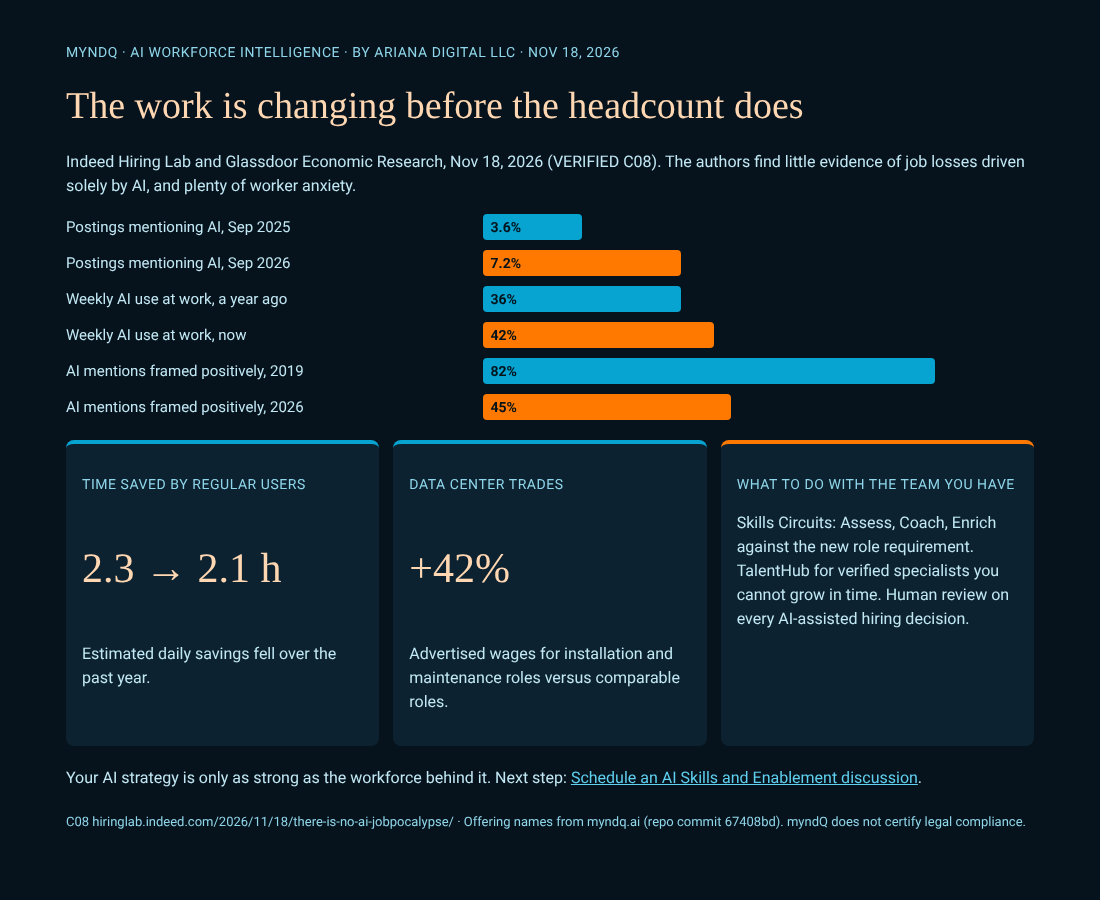
Indeed’s AI Tracker: share of US job postings mentioning AI rose from 3.6% in September 2025 to 7.2% in September 2026. Nearly two-thirds of AI-touched job titles sit outside traditional tech. Weekly AI use at work among employed respondents rose from 36% to 42%. Among regular AI users, estimated daily time savings fell from 2.3 to 2.1 hours.
On Glassdoor, reviews that mention AI were 2.6× as likely as a year earlier; AI-critical reviewers were 7.1× as likely as the base rate to mention layoffs. Data center installation and maintenance postings advertise wages about 42% above comparable roles.
2. Why leaders should care
Headcount may lag the work. Role requirements are picking up AI language before you have named reviewers, halt owners, and evidence paths for AI-assisted hiring or promotion. That gap is workforce risk as much as technology risk.
Your AI strategy is only as strong as the workforce behind it.
3. Cost-of-waiting view (arithmetic, not a forecast)
If a 40-person team spends 2.1 hours a day on AI-assisted tasks (Indeed’s average among regular users), that is 84 staff-hours a day whose control evidence is undefined until you name who supervises the work. Replace 40 with your headcount.
4. What to do with the team you have
Skills Circuits
Assess, Coach, Enrich against the new role requirement on the people already on payroll.
TalentHub
Verified specialists for roles you cannot grow in time.
Hiring Intelligence
Interview rounds with human review and retrievable evidence on AI-assisted hiring decisions.
EU Digital Omnibus (Regulation (EU) 2026/1744) deferred Annex III high-risk employment uses to Dec 2, 2027. NYC Local Law 144 still requires a bias audit within the prior year before automated employment decision tools are used. myndQ does not certify legal compliance.
5. Next step
Related: BLS role-requirement scorecard · Supervision self-check · Nov 18 Daily Market Scan